
Curved Glulam: The Rule of Thumb Behind Better Performance
Curved glulam has a way of making a building more memorable by creating a sweeping arch, a barrel roof, or a gently bowed beam that softens a square room. But before any of that curve exists on site, Buana always gets a question from architects or engineers: how tight can a glulam curve actually be?
The Physics Behind the Curve
Bending any material around a curve puts stress on it: the outer face stretches, the inner face compresses, and the tighter the arc, the more extreme that stress becomes. A thick lamination forced around a tight radius will reach its bending stress limit quickly, because there's more material fighting the curve at once. Therefore, the thickness of each lamination plays a critical role in determining how tightly it can be bent.
A thinner lamination can flex much further before hitting that same limit, simply because there's less material resisting the bend. A thinner lamination can flex much further before reaching that same limit because there is less material resisting the bend. For this reason, curved glulam does not use the same thick laminations as a straight beam. The tighter the radius, the thinner each layer needs to be to bend safely without fracturing or overstressing the wood fibers.
In short: radius and lamination thickness move together. Shrink one, and the other has to shrink with it.
What’s The Industry “Standard” and How Hardwood Changes It
As a general industry benchmark, structural glulam standards commonly reference laminations of around 1.5 inches (roughly 38mm) for gentle, large-radius curves, and tighten down toward laminations of under an inch (roughly 19–20mm) as the radius shrinks significantly. Published specifications from bodies such as the APA in ANSI 117-2025 set minimum code radii for standard lamination thicknesses in softwood species, with tighter radii requiring correspondingly thinner stock. These figures are a starting point for design conversations, not a guarantee, and actual achievable radii depend on species, grade, and moisture content.
On the other hand, hardwoods don't bend like softwoods. Density and grain structure both affect how much stress a lamination can absorb before it's pushed past its limit, which means the "standard" softwood ranges above don't automatically transfer to a hardwood species. This is why phrases like "minimum radius glulam beam" and "glulam lamination thickness chart" are searched so often by people specifying curved timber.

Buana’s Keruing glulam is a strong example of how hardwood can be engineered for curved structural applications. Keruing is a tropical hardwood with a dense, interlocked grain and a density that gives it superior load-bearing capacity, making it impact-resistant as a beam and suits in demanding structural applications. But that density also means the physics of bending it are different from a fast-growing softwood, and radius planning has to account for that from the start rather than borrowing assumptions from softwood span tables.

Buana Curved Heavy Hardwood Glulam
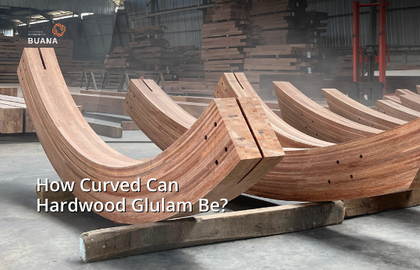
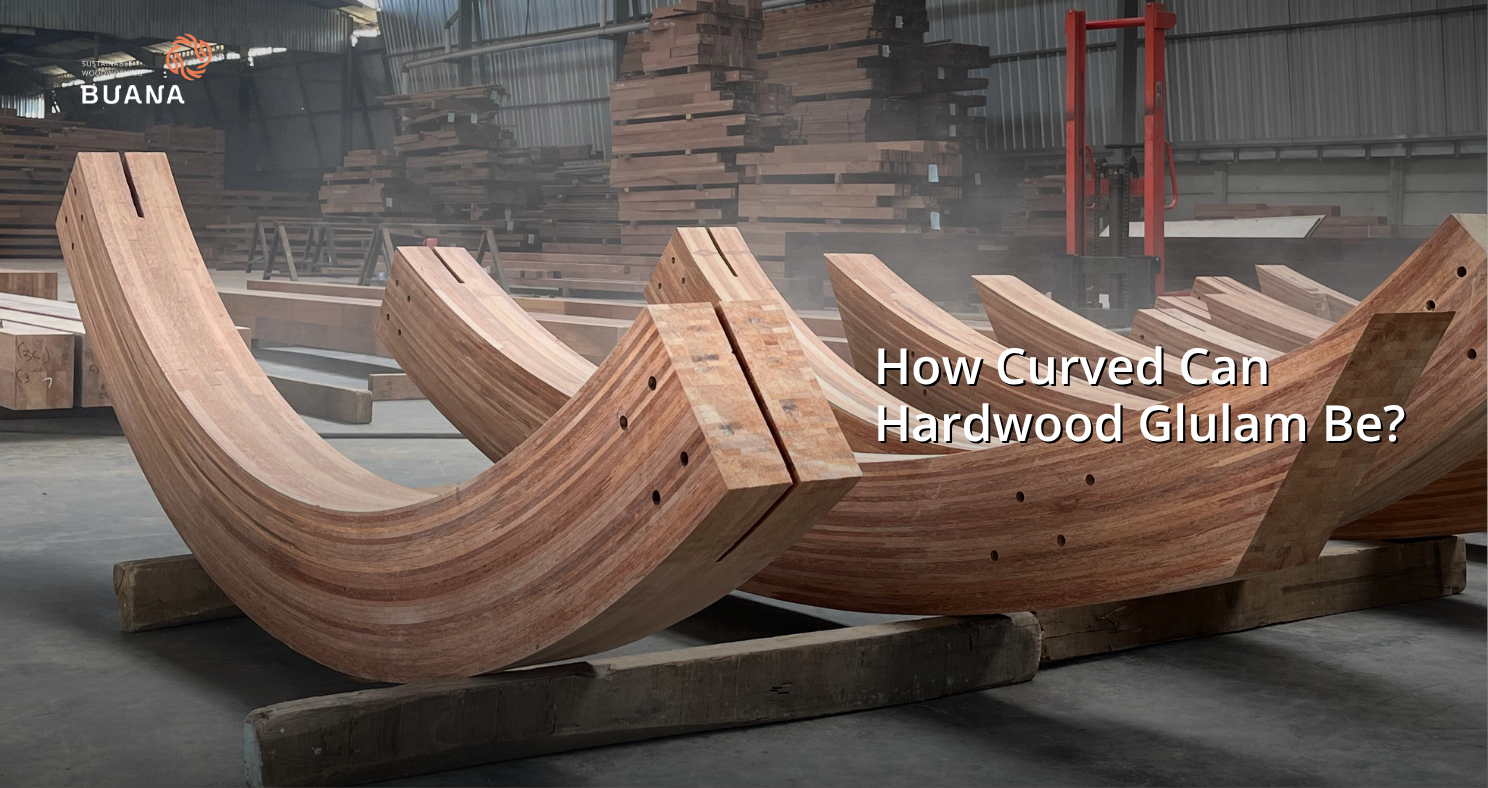
Buana engineered Keruing glulam to achieve the highly curved geometry for Alunan Pesisir design for Jia CURATED 2026. The concept called for extremely curved beams to express a woven pattern, requiring a specialized approach to the manufacture of the elements. The engineering process focused on determining the appropriate lamina thickness, fabricating custom molds to achieve the desired radii, and optimizing the pressing pressure to ensure dimensional stability. Through a series of trials and adjustments, Buana established the optimal fabrication parameters, enabling the production of curved glulam beams with consistent forms and structural stability.
For Alunan Pesisir, Buana successfully manufactured curved Keruing glulam beams in three different radii: 1,500 mm, 2,200 mm, and 2,100 mm. To improve the bendability of the timber and achieve the required curvature, the lamina thickness was reduced from the conventional 20 mm straight beam lamina to 7 mm. These engineered thinner laminas allowed the wood to conform more effectively to the curved molds while maintaining the stability of the adhesive and structure after pressing. This process enabled the realization of the project's distinctive geometry while demonstrating the potential of Keruing glulam for complex architectural forms.
Curved Glulam for Projects
Curved glulam is more than a structural solution. Its ability to follow organic forms gives architecture a distinct character through curves, rhythm, and visual identity, while supporting the structural demands of the building. These expressive forms can be designed not only for their visual impact, but also for strength, stability, and durability over time.
Whether you are an architect or engineer, Buana’s Keruing glulam enables you to explore organic architectural forms with confidence, bringing complex curves to life through the strength and excellence of Indonesian hardwood. Contact our team to discuss your project.